
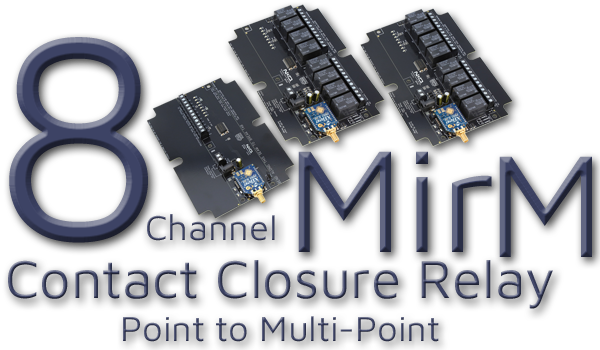
8-Channel MirM at a Glance...
- Sender Board Controls the Receiver Boards
- 8 Dry Contact Inputs on the Sender Board
- 8 Relay Outputs on Each Receiver Board
- Extend Contact Closures to Multiple Locations
- Sold as a Married Set - Onboard 900MHz Wireless Interface
- Reliable 900 MHz Radios Installed
- Line of Sight Operation
- 2-Mile Range
- Multiple Pairs will not Interfere with Each Other
- For Use in North America (US, Canada, Mexico) - Works Together Right Out of the Box!
- No Programming, Software, or PC Setup Required
- Simply Connect and Power On
Control Without Pulling Wire
Wireless MirM controllers give you instant contact-closure mirroring without running cables, trenching, or rewiring. Set them up once, and they stay synced - simple, reliable, and ready for real-world automation.
Contact Closure to Multi-Point Relay
The 8-Channel MirM Contact Closure to Multi-Point Relay allows you to control relays at multiple remote locations from dry contact closure inputs. The sender board includes 8 dry contact inputs, while each remote board includes 8 onboard relays.When the contact closure circuit is closed on the sender board, all connected remote relays energize simultaneously. The relays remain energized as long as the input stays closed. When the contact opens, all relays turn off.
This makes the MirM ideal for applications where one switch, sensor, or pushbutton needs to trigger multiple devices or systems at the same time across different locations.
Depending on your input device, the relay can be activated momentarily or held on continuously. For example, a pushbutton can provide temporary activation, while a toggle switch can keep the relays energized until switched off.
Each relay provides a dry contact output (no voltage), making it easy to interface with a wide range of equipment and control circuits.
💡 Relay Pros ProTip:
A single light sensor can automatically turn on lighting across multiple buildings - perfect for campuses, storage facilities, or multi-structure properties.
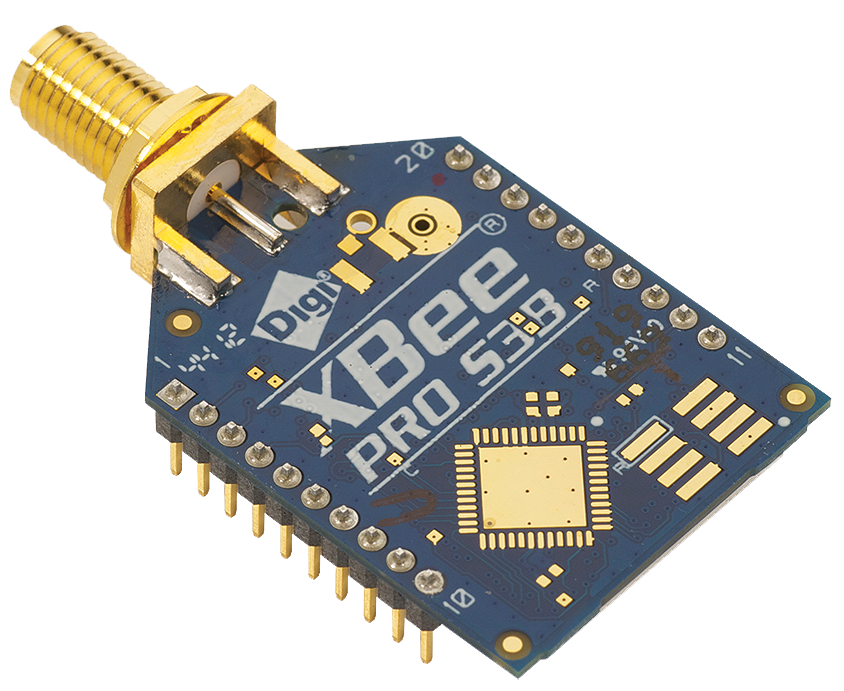
XBee-PRO 900 RF Module
Both the Sender and Receiver Boards feature a 900HP wireless module operating at 900 MHz. This module provides a reliable wireless link with a line-of-sight range of up to 2 miles (3.2 km), enabling dependable remote control in a wide range of applications.Step-by-Step Connection Guide
- Connect Your Device:
- Wire the contact closure output of your device to the input terminals on the Sender Board
- Power All Boards:
- Apply 12VDC Power to both the Sender and Receiver Boards
- Wireless Linking:
- The 900HP wireless modules automatically establish the long-range communication link (no configuration required in standard MirM systems)
- Use the Relay Output:
- Wire the relay contacts on the Receiver Boards to the circuit or equipment you want to control at the remote locations
- Trigger the Closure:
- When the contact closure activates at the Sender Board, all Receiver Board's relays mirrors that state almost instantly
Choosing the Right Relay Amperage
The 8-Channel MirM boards include one dry contact input on the Sender Board and one relay output on each Receiver Board. The key difference between the options is the amperage rating of the relay installed. Select a board that matches the amperage required for your application.- SPDT relays are available in 5-Amp, 10-Amp, and 20-Amp versions.
- An SPST relay is available in a 30-Amp version.
⚠️ Controlling Motors
If you're controlling high-current loads like motors or heaters, always choose a relay with extra amperage headroom. Running a relay at its maximum rating can shorten its lifespan.
If you're controlling high-current loads like motors or heaters, always choose a relay with extra amperage headroom. Running a relay at its maximum rating can shorten its lifespan.

